


 Progressive
 Allstate
 Liberty Mutual
 Travelers

Context
Two ways to shop for car insurance
Savvy.Insure, by Trellis, helps people find better car insurance. Customers could shop in one of two ways.
- Linked. Sign in to your current insurer, say Progressive, and we pull your details from that account to find comparable quotes.
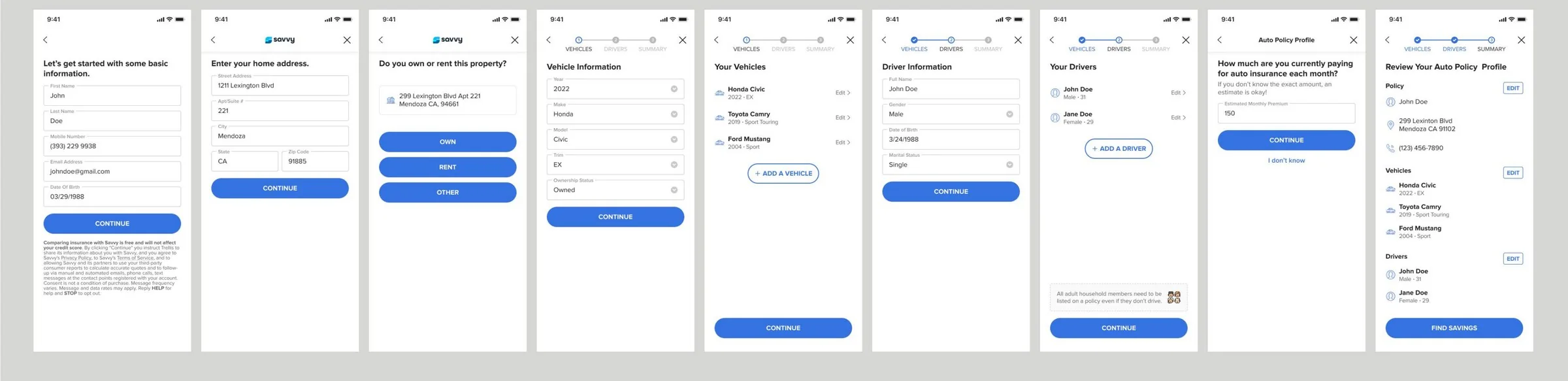
- Unlinked. For anyone without insurance, or who couldn’t sign in: a series of questions asking for the minimum we needed to quote them.
Both start on the homepage, and every step from there to a quote is where the business wins or loses.
Opportunity
No designer for two years
Savvy hadn’t had a designer for two years, and the CEO believed there were many chances to lift conversion across the main car insurance flows.
So the opportunity wasn’t one problem but many: the homepage, the linked flow and the unlinked flow. The job was to find the biggest wins quickly, and prove them.
Approach
Fifteen experiments in three months
Unfortunately, I no longer have access to all the experiments, files and visuals, so here I’ll show the one I do have: one example of the 15.
One example: ask for the car before the phone number
Four in ten people gave up before seeing a quote. From 17 to 31 May 2023, only 58.7% of people who started the unlinked application finished it.
Completion of the unlinked application
Baseline, 17–31 May 2023
41.3% gave up before seeing a quote
Hypothesis: changing the order of the unlinked application will increase conversion.
The control opened by asking for name, phone, email and date of birth, before Savvy had given anything back. V2 starts with the car and the drivers, builds up to the policy, and only asks for contact details at the very end, as “Where should we send your offers?”
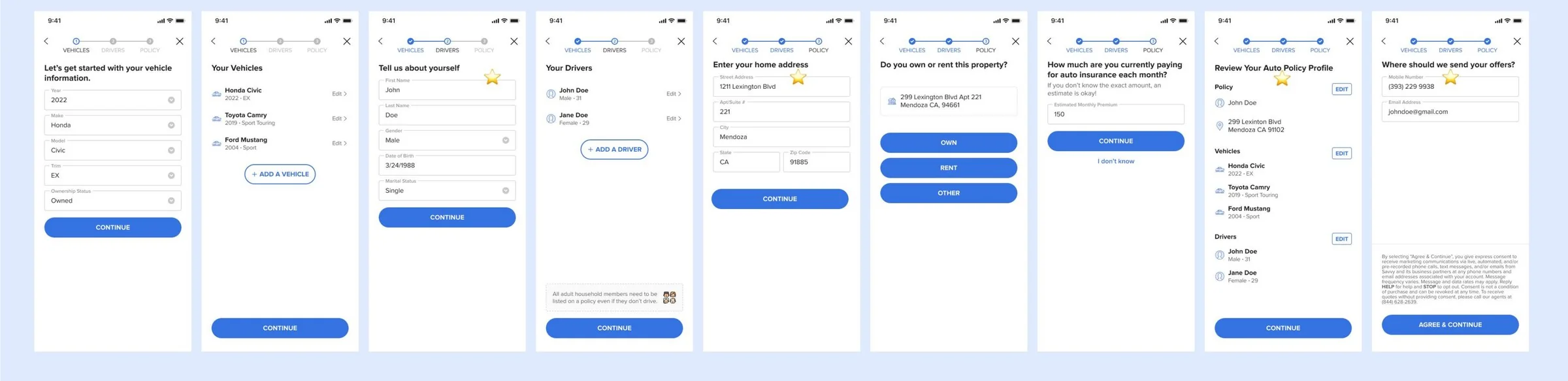
Completion of the unlinked application
A/B test, 1–9 June 2023
+8.6 points, a 14% relative lift
Also: a new homepage
I also redesigned the homepage, where both paths begin, to make the value clear up front: better insurers, real savings, and help at no cost.


Outcome
$3.5MM in predicted annual revenue
- Across around 15 experiments in three months, the wins added up to $3.5MM in predicted gross annual revenue.
- The re-order test alone lifted completion of the unlinked application from 60.4% to 69.0%, a 14% relative improvement. V2 then shipped to everyone.
- We left the team with the infrastructure to keep testing with ease, and a shared way of deciding what to build.
How the $3.5MM was predicted
We knew what every completed application was worth, so more completions translated directly into revenue. Savvy earned in three ways:
- Insurer adverts with no quote. Paid per click, like Google Ads. Insurers bid to rank first, and some paid more for certain customers: a veteran, say, was worth more to an insurer for veterans.
- Insurer adverts with a direct quote. Also paid per click.
- A policy closed by our licensed agents. When a customer’s data was strong, our agents helped them switch, and we earned the full quote, less operating costs.
What we learned
- People need Savvy to feel valuable before they give their info. Order matters.
- Learning is more important than being right. Good testing infrastructure means more people share ideas, and it takes the HiPPO out of decisions.